A developer submits an episode package containing a manifest, assets, research and creative instructions. DGX Spark discovers it in Google Drive, prepares the production, generates the required media, assembles the film, checks the result and delivers an Unlisted YouTube video with its thumbnail, description and timed captions. The channel owner reviews the finished video and chooses when to make it public.
That is the workflow Labverse has designed. This tutorial explains the implementation blueprint from our November 2026 production research. The Drive intake, unattended coordination and YouTube API delivery are planned integrations awaiting implementation and qualification. Existing documentary renders and the Media Studio procedures provide the starting point.
The intended human involvement is submitting the input and deciding on public publication. Initial account setup and exceptional failures still need an operator. The system should preserve completed work and explain a blocked stage when an account grant expires, a package is incomplete or a material source question cannot be resolved.
See the complete workflow
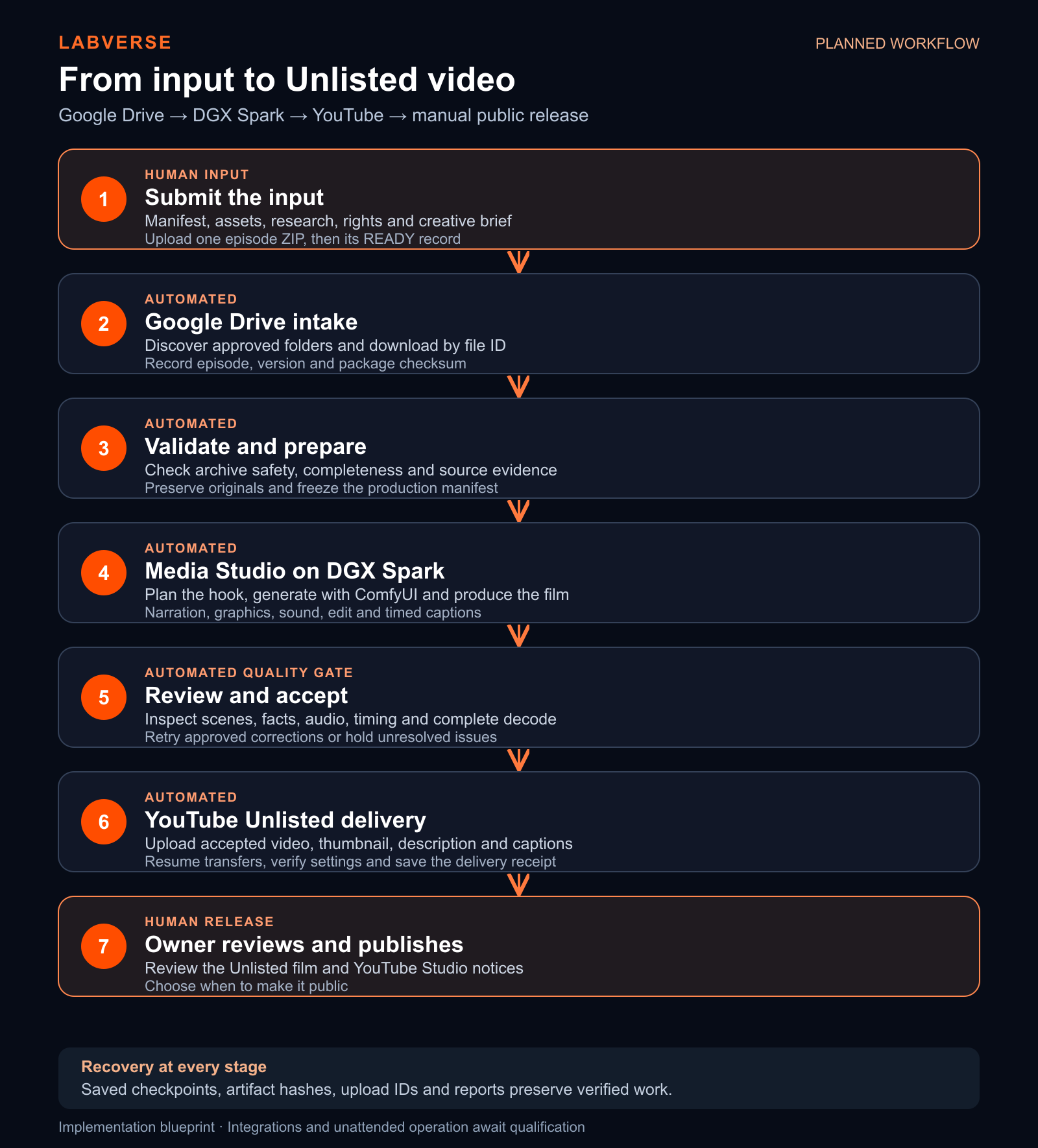
Open the workflow diagram at full size. Routine production follows the middle stages. The owner supplies the input and makes the final public-release decision.
Define what counts as a finished delivery
The output is a complete publishing package. Alongside the master video, retain the thumbnail, timed subtitles, title, description, search phrases, measured chapter timestamps, source credits, accepted asset hashes and delivery receipt. A receipt connects the exact reviewed files to the YouTube video ID.
The proposed path is sequential.
- Submit an immutable ZIP and completion record to the approved Drive area.
- Discover, download and validate the package on Spark.
- Prepare a canonical manifest and verify consequential claims and sources.
- Run the existing media production workflow with bounded creative tasks.
- Review all scenes, sound, captions, thumbnail and publishing text.
- Upload accepted artifacts as Unlisted and verify delivery.
- Return the link and report to Drive, with a checksummed PC copy when available.
Successful encoding, accepted quality, completed upload, provider processing and public publication each have their own recorded result.
Prepare the input contract
Use a ZIP with one episode folder. Preserve the supplied manifest and supporting documents alongside the canonical production version created later. A developer should be able to prepare the package through one packaging helper that also creates its completion record.
episode_example/
  manifest.json
  RESEARCH_AND_STORYBOARD.md
  YOUTUBE_PUBLISHING_PACKAGE.md
  assets/
  sources/
  rights/
The manifest identifies scenes, narration, visual requirements, timing and any supplied media. The publishing package describes the intended title, audience, hook, description, thumbnail treatment and search vocabulary. Source records connect factual claims and archival material to evidence. Rights records explain the permitted use of supplied images, music and voices.
Upload the ZIP first and READY.json last. This example illustrates the proposed contract. Its ID, size and digest are placeholders.
{
  "schema_version": 1,
  "episode_id": "episode_example",
  "version": 1,
  "ready": true,
  "package_file_id": "COMPLETED_DRIVE_UPLOAD_ID",
  "package_name": "production_package.zip",
  "package_size_bytes": 1000000,
  "package_sha256": "aaaaaaaaaaaaaaaaaaaaaaaaaaaaaaaaaaaaaaaaaaaaaaaaaaaaaaaaaaaaaaaa",
  "manifest_path": "episode_example/manifest.json",
  "publishing_package_path": "episode_example/YOUTUBE_PUBLISHING_PACKAGE.md"
}
The adapter checks the actual file parent, byte count and SHA-256 against this record. A folder name alone is too ambiguous to identify an approved submission. Configure the real folder IDs during setup and require a new version when accepted input changes.
Connect Drive through the API
The planned production area has Incoming, Source Archive, Delivery Reports and Finished Videos folders. Spark performs a paginated startup scan and later uses a saved change token to discover new work efficiently. A periodic reconciliation of the approved folders recovers from missed events or an invalid cursor. Google documents the start-page-token and change-list operations for this purpose. Drive change tracking
Download the ZIP by its file ID using an authorized blob download. Write partial bytes to a temporary file, preserve the source identity while resuming, and verify the complete digest before accepting the archive. Native Google documents need their appropriate export operation. Keep the production ZIP as a normal binary file. Drive download and export guidance
Qualify authorization using a file uploaded by a real developer after setup. A working browser connector does not establish that Spark can discover future submissions. Likewise, a folder allowlist in the adapter is an application control, and the chosen OAuth scope determines the underlying account access. Drive authorization scopes
Establish storage ownership before enabling retention. A file uploaded into someone else's personal shared folder can use the uploader's allowance. Workspace Shared drives have a different ownership model. For personal storage, the plan proposes an owner-authorized archive copy with verified identity and bytes. Measure available capacity and retain the relationship between original and copied file IDs. Google Drive storage and ownership
Validate the archive before production
Check archive entries before extraction. Reject paths that escape the episode directory, symbolic links, device entries, duplicate paths and excessive expansion. Validate the manifest schema, referenced files and package limits. Preserve original bytes and create a separately recorded canonical manifest for production.
Incoming instructions can describe the film, but they cannot select credentials, change the destination channel, execute a bundled script or alter the publication policy. The trusted media runtime and its tools are installed separately from submissions.
Use the episode ID, version and package hash as the delivery identity. An identical resubmission should return its existing progress or receipt. The same version with different bytes becomes a conflict. A new filename or an archive copy must not start a duplicate film.
Bring Media Studio onto Spark
The existing Media Studio package contains producer, creative lead, writer, director, cinematographer, art director, Spark operator, sound, editor, rights reviewer, quality reviewer and channel-producer roles. Its procedures cover creative development, screenwriting, rendering, sound and captions, post-production and release preparation.
Adapt the roles required by the documentary format into a versioned runtime bundle. Include trusted instructions, role definitions, selected skills, renderer adapters, inspection tools and qualification checks. Record the bundle's hashes and dependency versions. Each role receives a bounded task with named inputs, permitted edits, expected artifacts and acceptance criteria.
The first proposed model policy is hybrid. Local Qwen assists with bounded classification, summaries, prompt drafts and metadata drafts after qualification. Hosted reasoning and retrieval support consequential source questions and independent editorial acceptance. Image, speech, motion and encoding work uses the existing Spark workers, qualified for each production task. Visual and audio review require tools and models that can inspect those media.
The desktop's signed-in sessions and available tools need explicit counterparts on Linux. Prove role discovery, actual tool calls and a complete small job under the unattended account before transferring production responsibility.
Build around the existing media engine
Keep scene IDs stable while reconciling the supplied script, storyboard and assets. Record historical corrections and the evidence behind them. Separate genuine archival material, explanatory graphics and labeled AI reconstructions in the production ledger.
ComfyUI is the generation interface for workflows that use it. Submit a pinned API-format graph, record the returned prompt_id, follow execution and inspect its saved history and outputs. A browser editor does not need to be open for these server operations. Node availability and exact model paths still need checking on the target Spark. ComfyUI server routes
Composition, narration, audio mixing, forensic overlays, captions and final encoding remain responsibilities of the existing production tools. Move reusable launch helpers into durable tools and parameterize the episode path. Prove one previously accepted episode still meets its scene and quality contract after that work.
Serialize heavy GPU production. Before starting a stage, confirm model availability and memory requirements, then save its settings and output identity. Retain accepted scene assets so recovery can reuse them. The exact treatment of an interrupted encode depends on the encoder and stage boundaries.
Write hooks that the film can deliver
Treat a hook as a specific promise to the viewer. For an engineering documentary, that might be a surprising contradiction, an unresolved mechanism or a decision made under time pressure. Resolve the promise with evidence inside the film.
For example, a structural engineering episode might open with a seemingly ordinary design detail that changes the building's response to wind. Its opening scene should establish the detail, show the consequence clearly and give the viewer a reason to follow the explanation. The title, thumbnail and first spoken lines should describe the same story.
The creative lead can propose several openings, the writer can align them with the verified script, and an independent reviewer can check that the selected hook exaggerates neither the evidence nor the stakes. Save alternatives and the reason for choosing one. Virality is an outcome to measure after publication, rather than a property the generator can guarantee.
Generate search and publishing metadata from accepted content
Draft the title, short description, topic phrases and thumbnail text from the canonical story. After the final edit, derive chapters from actual timestamps and reconcile credits against the selected assets. Remove promises about scenes or conclusions absent from the accepted film.
Use relevant subject names and natural search phrases in the title and description. Tags can capture useful variants and misspellings. YouTube describes title, thumbnail and description as more important discovery information than tags, so avoid treating a long keyword list as the publishing strategy. YouTube tag guidance
Keep the high-resolution thumbnail master and prepare an upload derivative that meets the current endpoint's requirements. Check the text at small size and inspect the attached result after upload. YouTube thumbnail endpoint
Make acceptance evidence reusable
Require scene coverage, source review and inspection of the rendered film. Technical checks include full media decode, expected duration, audio presence, dimensions and subtitle timing. Creative checks include visual continuity, narration intelligibility, accurate graphics, appropriate reconstructions and agreement between the opening promise and the story.
Store review results against artifact hashes. If the master changes, invalidate affected acceptance records and rerun those checks. Keep revision rounds bounded. An unresolved finding holds the episode with a precise explanation and preserves completed work.
Automated speech comparison can detect omitted words. Signal checks can detect clipping or silence. Motion playback and listening still need a qualified inspection capability in the production profile. Demonstrate that capability during the pilot before claiming unattended quality coverage.
Upload only the accepted package as Unlisted
Before creating a YouTube upload, verify the authorized channel, accepted master hash, metadata and any existing operation receipt. The trusted adapter constructs the upload settings. Set status.privacyStatus explicitly to unlisted, omit publishAt, and disable subscriber notifications. For this documentary format, the plan sets status.containsSyntheticMedia to true and requires accurate audience and paid-promotion declarations. The input package cannot request public visibility. YouTube video insertion
Use a resumable transfer and protect its saved session reference. Persist the video ID as soon as it is known, before attaching the thumbnail, captions or Drive report. After interruption, query the existing transfer and reconcile its result. An uncertain final response must not automatically create another video. YouTube resumable uploads
Upload the accepted timed captions and save the track ID. Qualify the OAuth permissions for the whole operation, including captions, which have their own authorization requirements. Read back the track and provider status before recording completion. Caption insertion reference
Finally verify channel identity, Unlisted visibility, processing, metadata and attachment evidence. Write the local receipt and sanitized Drive report. If report delivery fails, retry that operation against the saved video ID. Unlisted links can be shared by anyone who receives them. The owner reviews the film and YouTube Studio notices before choosing public publication.
Recover when Spark restarts
Use OS startup configuration and filesystem locks around the existing tools. Keep per-episode progress files with the source identity, selected manifest, completed artifacts, review records, attempts and external operation IDs. Record state atomically.
At startup, reconcile saved state with actual processes and files. Reuse a running render or accepted scene artifacts when valid. Resume a recorded upload instead of creating a fresh one. A disconnected PC can receive its verified copy later while Spark continues eligible work.
The same recovery discipline applies after delivery. Once the owner publishes or edits a delivered video, the automation should respect that action. Ordinary reconciliation must not overwrite the owner's later publication choices.
Implement and qualify in six stages
- Verify Drive ownership, folders, API grants, channel access, Spark runtime and operating budgets.
- Build the packager and Drive adapter, including partial-file handling, safe extraction and duplicate detection.
- Parameterize the established engine and migrate the required Media Studio tools and roles.
- Add artifact-bound progress records, independent reviews and bounded correction loops.
- Implement resumable Unlisted upload, caption and thumbnail attachment, readback and delivery reports.
- Test a representative pilot, then a sustained trial with reboots, offline submissions, duplicate packages, failed transfers and revoked access.
The target is routine production from a complete input to a verified Unlisted delivery with no repeated manual handoffs. Qualification must demonstrate that behavior before the standing loop is enabled.
For the existing public media foundation, explore DGX Spark Media Lab and our local video and voiceover workflow guide. The public starter and this proposed automation describe different delivery scopes. To discuss a production workflow for your team, contact Labverse.