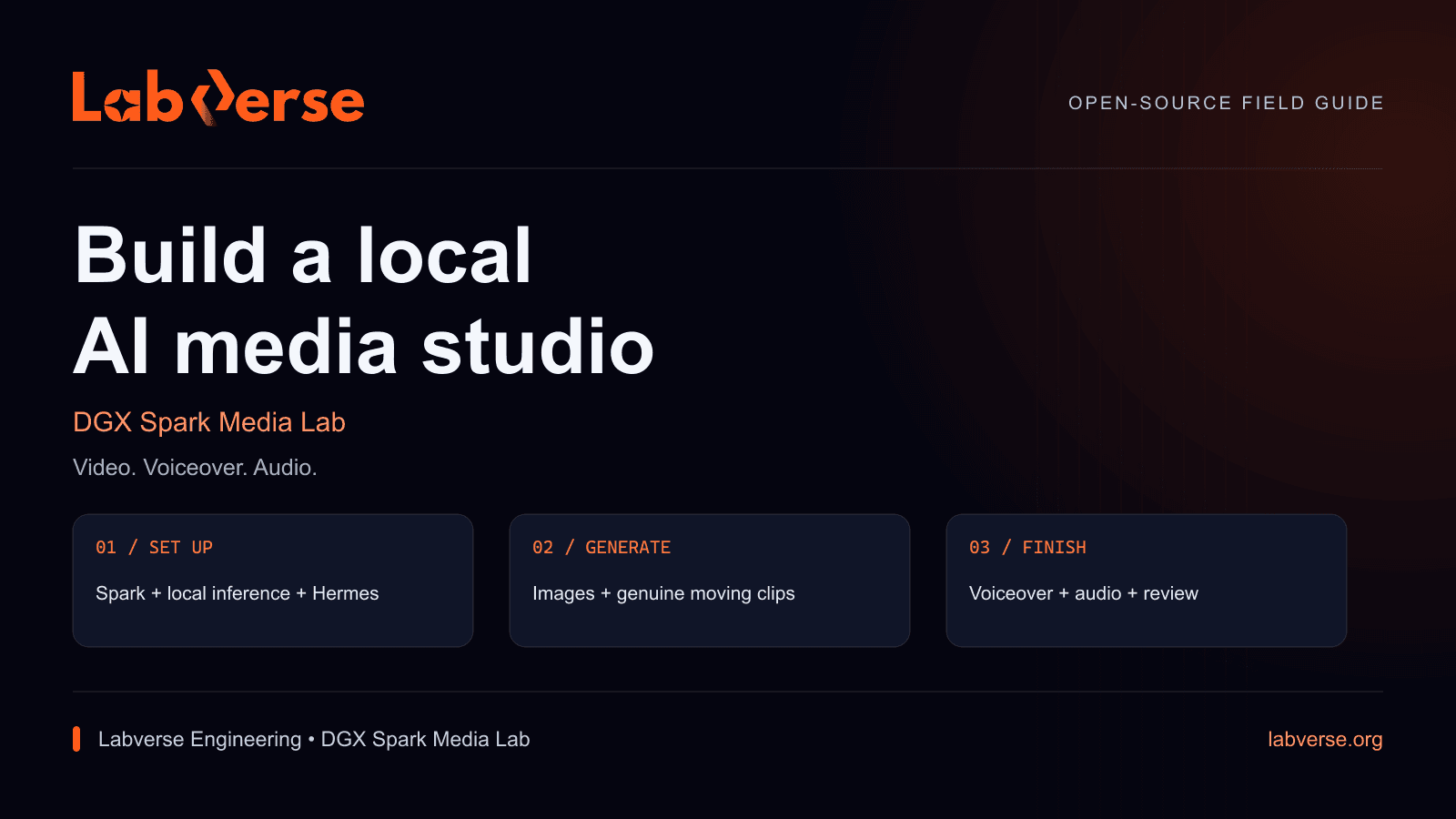
Labverse is sharing the DGX Spark media work as a public, practical learning resource. The guide connects local planning and agent tools to original images, moving footage, voiceover and a finished edit.
The public package is available under the Lab-Verse GitHub organization. It contains three tutorials, selective pinned model metadata, ComfyUI workflow files, local helpers, troubleshooting and contribution guidance.
Read the complete series
- DGX Spark Tutorial 1: Set Up Local Inference and Hermes
- DGX Spark Tutorial 2: Generate Images and Moving Video with ComfyUI
- DGX Spark Tutorial 3: Local Voiceover, Audio and Film Finishing
Open the public GitHub repository · Download release v0.1.0
What you can build
Start with a small original scene: write a short script, generate a reference image and a moving clip, audition narration, add an original audio bed, align captions and inspect the result. Each stage has its own evidence. A downloaded checkpoint is not a successful generation test, and a video that decodes is not automatically a convincing film.
The tutorials cover:
- Spark and Hermes: isolated ARM64 runtimes, a verified local text route, profiles, permissions and GPU handoff.
- Images and video: Z-Image and Wan workflows, native prompt IDs, measured canaries, recovery and source-frame ledgers.
- Voice and finishing: experimental local Indic-Mio narration, pronunciation auditions, modest pacing changes, procedural background music, mixing and caption review.
The lessons behind the guide
The research records include a 147.2917-second full-motion Urdu experiment assembled from 30 locally generated Wan clips. A separate later Wan 2.1 14B canary produced 81 frames at 512×320 and 16 fps: 5.0625 seconds of video, with 286.62 seconds measured for generation. These are separate experiments with different settings, not a general throughput benchmark.
One practical limit shaped the workflow: the research text server reserved roughly 99 GiB of shared memory. Heavy video inference needed sequential GPU use and a verified return to text inference. Keeping a gateway process online did not mean its local reasoning model stayed available during that pause.
We also learned to inspect the creative result. An early mixed-media treatment passed technical checks but was rejected because too much of its visual track animated still images. Later motion tests showed that a requested push-in can become a pullback. A prompt, a unique-frame count and a successful decode cannot certify acting, physics or precise camera control.
For Urdu speech, names, nasal vowels and phrase boundaries required listening. ASR can flag missing words, but cannot settle naturalness or every pronunciation detail. The tutorials preserve that distinction.
What has been checked
The public repository passed 18 out of 18 CPU/offline CI tests, including actual WAV generation and full FFmpeg decode. Model/source pins, relative document links, workflow structure and bounded failure/path behaviors were checked. The publication record links the evidence.
This is a reconstructed public starter based on the dated private research environment. A clean end-to-end Spark installation of this public edition has not yet been qualified. The latest separate 15-shot portfolio render lost connectivity after nine last-verified sources; its final outcome was unknown at the guide's snapshot. We do not describe that batch as complete.
Privacy, models and contribution
Private voice recordings and embeddings, credentials, account sessions, internal archives, generated films and model weights are excluded. The public speech helper uses an experimental zero-embedding baseline. The music example is original procedural synthesis; acquired ACE-Step models are not presented as a successful neural music benchmark.
Repository licensing does not override third-party model or auxiliary-weight terms. Use rights-cleared source assets and obtain appropriate voice/likeness permissions for the intended use. Review model notes before downloading.
We welcome measured fixes, fresh Spark installation reports, minimal workflows and native-language speech feedback. Include versions, settings, timings and observed limits. Contribution guidance explains what to share safely.
Start with one reviewed canary
Follow the setup tutorial, prove the local route, generate a short moving clip and a short narration, then inspect both. Extend the project only after those stages work on your installation.
Read the complete series
- DGX Spark Tutorial 1: Set Up Local Inference and Hermes
- DGX Spark Tutorial 2: Generate Images and Moving Video with ComfyUI
- DGX Spark Tutorial 3: Local Voiceover, Audio and Film Finishing
Open the public GitHub repository · Download release v0.1.0
For help designing a local AI workflow around a real engineering or content-production problem, contact Labverse.