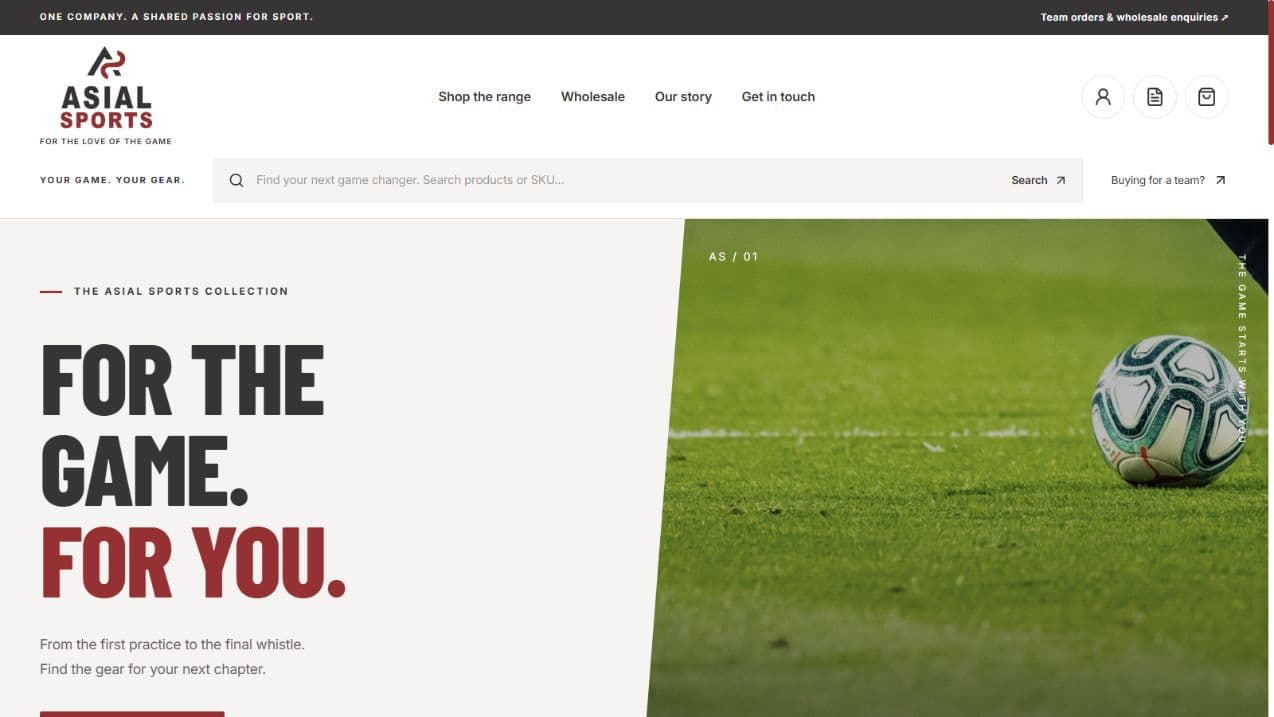
A custom sportswear storefront has to carry more information than an ordinary product basket. Artwork placement, garment sides, player names, quantities, sizes, and production notes all affect what the customer expects to receive. A browser preview helps a buyer express intent, but production needs a stable record of exactly what was reviewed.
The ASIAL Sports B2B case study introduces the storefront and Design Studio. Its implementation documents and backend show a deliberate sequence: submit a design revision, review a staff proof, record the customer's decision, connect the quotation and order, and explicitly release production. The lessons here come from those source contracts, not from an invented conversion or manufacturing improvement.
Separate the editable project from the submitted revision
During editing, autosave should let a buyer experiment without losing work. That mutable project is a poor manufacturing reference because it can change while staff are reviewing it. ASIAL freezes the submitted design document, quantities, and roster into a revision. Later editor changes cannot silently rewrite that submission.
A revision should identify the template version and relevant assets as well as the visual design. Keeping a reference to a mutable template can undermine an otherwise immutable document. ASIAL's source rejects edits to published template versions and asks staff to create a new version. This makes it possible to understand which rules and physical coordinates applied at submission.
Treat the preview as a communication aid
The Design Studio uses a bounded rendering model for garment views, text, colors, artwork, and roster personalization. Its implementation notes distinguish approximate browser colors and fonts from the staff-supplied production proof and physical sample. That distinction belongs in the buying journey at the decision point, not only in internal documentation.
Place practical preflight feedback beside the affected control. If artwork is too small for its intended placement or extends outside an allowed region, keep the buyer's work and explain the next step. An attractive preview should not hide an unresolved production issue. Equally, a warning should not imply that software can judge every fabric, print method, or manufacturing constraint.
Bind approval to one current proof
A customer should approve an identifiable artifact, not a general statement that a project looks acceptable. ASIAL records proof status, the deciding actor, notes, and a decision timestamp. The backend checks ownership so that the customer associated with the design makes the approval decision.
A replacement proof supersedes prior proof approvals and outstanding quotations in the reviewed implementation. The customer therefore cannot accidentally approve a newer file by relying on an earlier decision. An illustrative decision record might look like this:
{
  "revisionId": "sample-revision",
  "proofId": "sample-proof",
  "decision": "approved"
}
These are example identifiers. A production handler must derive the actor from authentication, check current state, and save the decision transactionally.
Make stale screens fail clearly
Two browser tabs can hold different versions of the same project. If one saves after the other, accepting both without a version check can lose work. ASIAL's documented browser exercise includes recovering a conflicting edit as a copy, which preserves the buyer's attempt while making the competing version explicit.
HTTP conditional requests provide a standard approach to rejecting stale updates through validators such as ETags and If-Match. An application can also use an explicit version field. Whichever mechanism is chosen, a conflict response needs useful UI: explain the newer version, retain the local draft, and offer a deliberate resolution.
Keep quotation and order references aligned
A buyer approving one proof should not later accept a quotation for another revision. In ASIAL's workflow, the custom quotation follows customer proof approval and staff capacity confirmation. Quote acceptance checks the matching proof and pins the same design references into the order.
This sequence is a product choice. Other manufacturers may prepare prices earlier, but they still need an explicit point where the approved artifact, quantities, commercial terms, and order become bound together. Keep those relationships as structured identifiers and snapshots rather than depending on an email thread or a filename that can be reused.
Release production through a separate guarded operation
Approval and production release answer different questions. A customer can confirm the artwork while staff still need to confirm capacity or the commercial order. ASIAL's reviewed release code checks a matching accepted quotation, current approved proof, confirmed capacity, an eligible order state, and a paid transaction in the order currency covering the order total. Its current workflow does not enable partial-payment or credit-term release.
Those checks belong on the server at release time. A disabled button in the browser is helpful feedback but cannot enforce the rule. The implementation also uses transactions and row locks around relevant transitions. PostgreSQL's locking documentation explains the coordination mechanism; the application must still choose a consistent lock order and handle conflicts or retries.
Keep private artwork and operational events accountable
Artwork and roster data should be available only to the owning buyer and authorized staff. An unguessable URL is not a substitute for an ownership check. ASIAL's design assets use authenticated access in the reviewed implementation, and exports carry the revision context required to interpret them.
Record the event that explains a transition: submission, proof replacement, customer decision, or production release. Send notifications after recording the business event, and show notification failures separately. A missing email should not change whether approval exists. After an order has progressed, an amendment should follow an explicit process rather than silently replacing the proof.
Takeaway
A strong B2B customization journey connects creative freedom to a precise approval record. Preserve drafts, freeze submitted revisions, supersede outdated proofs, and recheck commercial conditions when releasing production. The result is a workflow people can inspect and operate, with clear responsibilities for the buyer, reviewer, and production team.